
Information for families in crisis. Action for everyone who wants to help.
Crisis Assistance Ministry’s vision is to inspire our community to justice and generosity as we provide help, hope, and understanding to people struggling with limited financial resources.
For many low-income neighbors, housing stability depends on a fragile balance. High rental costs, stagnant wages, and a shortage of affordable housing have left thousands of families housing-burdened, where a single unexpected expense, such as a car repair, a medical bill, or a reduced work schedule can lead to a missed rent payment and the threat of eviction.
In 2025, Mecklenburg County recorded 52,625 eviction filings. Behind each filing is a household facing the possible loss of its home, and often its stability, its children’s schooling, and its access to future housing.
As Brian Goldstone wrote in “There Is No Place for Us: Working and Homeless in America,” “Families are not falling into homelessness. They’re being pushed.” Eviction prevention is how a community pushes back.

In our first blog, we walked through the eviction process in North Carolina. In this second installment, we turn to what can be done to stop that process before it upends a family’s life. We’ll explore eviction prevention as a continuum of support, from pre-filing prevention to post-filing intervention, to longer-term stabilization, and look at what strong eviction prevention systems have in common.
Understanding the Eviction Prevention Continuum
Eviction prevention is often thought of as a single service, such as emergency rental assistance. In reality, effective eviction prevention is a continuum of services that support households at different stages of a housing crisis. The continuum begins before an eviction is filed, continues after court action has started, and extends beyond the immediate crisis to help families remain stably housed over time.
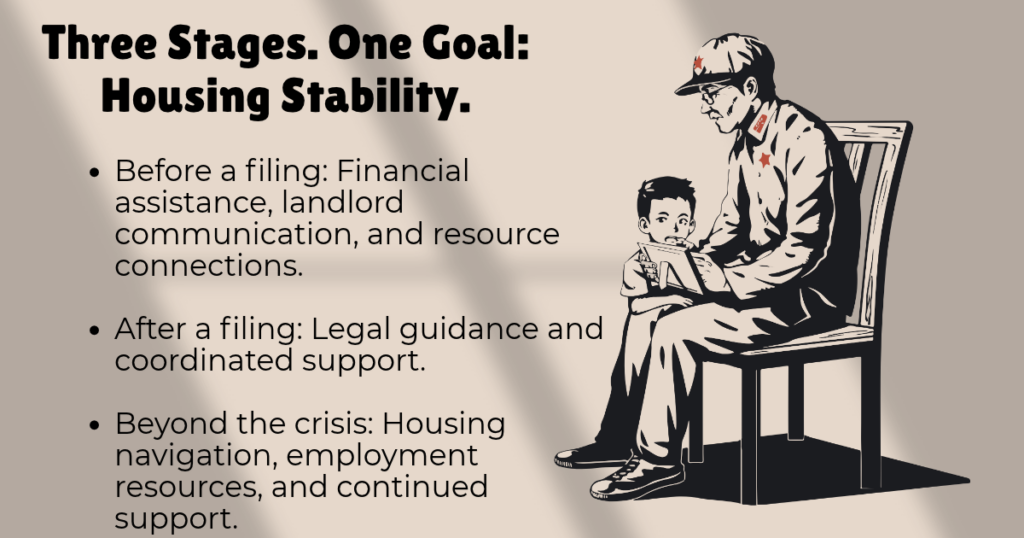
These three stages work together to strengthen housing stability:
- Pre-filing prevention, which focuses on resolving housing challenges before an eviction case is filed.
- Post-filing intervention, which helps households navigate the legal process after a case has begun.
- Longer stabilization, which supports families as they recover from a housing crisis and work toward lasting stability.
No single organization provides every service. Instead, effective eviction prevention depends on partnerships among nonprofit organizations, legal service providers, housing agencies, landlords, local government, and other community partners working toward the shared goal of housing stability.
Pre-Filing Prevention: Addressing Problems Before They Reach Court
The most effective eviction prevention often happens before a landlord files an eviction case. Many households experience temporary financial setbacks caused by job loss, reduced work hours, unexpected medical expenses, family emergencies, or other circumstances beyond their control. Without timely assistance, these challenges can quickly lead to missed rent payments and eventually an eviction filing.
Pre-filing prevention focuses on addressing these challenges early through services, such as:
- flexible financial assistance
- landlord communication and mediation
- case management
- connections to community resources
These services recognize that many housing crises are temporary and that early intervention may help households regain stability before legal action becomes necessary.
Avoiding an eviction filing is important for another reason. As discussed in our first blog, once an eviction case is filed, it becomes part of the public court record. Preventing the filing itself may help preserve future housing opportunities while allowing families to resolve their immediate financial challenges.
Organizations like Crisis Assistance Ministry play an important role during this stage by helping households access financial assistance, identify available resources, and develop plans that support continued housing stability. Their work is strengthened through partnerships with landlords, community organizations, and other service providers that recognize housing stability as a shared community responsibility.
Post-Filing Intervention: The Importance of Legal Representation
Even after an eviction case has been filed, there are still opportunities to support housing stability. The period between filing and the court hearing is often measured in days, making it essential for households to seek assistance as quickly as possible.
Legal services organizations can help tenants better understand the court process, identify potential legal issues, prepare for court, and explore available options based on their individual circumstances.
In some cases, legal representation or legal advice may help facilitate negotiations between landlords and tenants that result in payment agreements or other resolutions that reduce disruption for everyone involved. Even when a household cannot remain in the current home, legal assistance may help families better understand their rights and responsibilities while providing additional time to prepare for a safe transition.
Post-filing intervention is not limited to legal representation alone. Housing counselors, nonprofit organizations, and other community partners can continue working alongside families by helping them identify financial resources, coordinate services, and plan for their next steps. Together, these efforts recognize that helping families navigate a housing crisis is about more than responding to a court case. It is about supporting informed decision-making during a difficult and often stressful time.
Longer Stabilization: Building a Foundation for the Future
Eviction prevention does not end when rent is paid or a court case is resolved. Many families continue to face challenges after the immediate crisis has passed. They may still be working to rebuild savings, secure stable employment, address transportation needs, or connect with other community resources that support long-term success.
Longer stabilization focuses on helping households remain housed after the crisis by connecting them with services that promote ongoing stability. These services may include:
- housing navigation
- budgeting support
- employment and workforce resources
- benefits access
- and continued case management

By helping households address the underlying factors that contributed to the housing crisis, communities can reduce the likelihood that families will experience repeated housing instability in the future. Longer-term stabilization also strengthens the broader community. Stable housing supports children’s education, workforce participation, neighborhood stability, and overall community well-being.
What Strong Eviction Prevention Systems Have in Common
Effective eviction prevention relies on unified systems where no single entity works in isolation. Rather than placing the burden solely on landlords or tenants, thriving communities treat eviction prevention as a collective investment. This approach creates a ripple effect of benefits that strengthens the entire community. Key elements include several common characteristics.
- Coordinated Access: Families should be able to connect with the right services as early as possible without navigating multiple disconnected systems.
- Strong Community Partnerships: Longer-term housing stability is built on active partnerships between local government, legal services, nonprofits, philanthropic groups, and housing providers.
- Flexible Resources: Housing crises rarely follow the same pattern. Flexible service models and funding are critical to meeting the specific needs of each household.
- Information Sharing: Responsible data sharing and communication among partners can help identify community trends, improve service coordination, and strengthen prevention efforts.
Conclusion:
Eviction prevention is about more than avoiding a court case. It is about helping families remain safely housed, supporting landlords in resolving disputes, and strengthening the systems that promote housing stability.
When communities invest in prevention, they create opportunities to address housing challenges before they become housing crises. Even when legal action has already begun, coordinated services can help families better understand their options, navigate the legal process, and work toward stability. Communities that invest in prevention reduce both immediate displacement and the long-term instability that can follow an eviction filing.
If you are experiencing a housing crisis in Mecklenburg County, consider reaching out to the following resources:
- Crisis Assistance Ministry: For rental assistance, housing stabilization, and prevention services.
- Legal Aid of North Carolina or Charlotte Center for Legal Advocacy: For legal information and representation for eligible households.
- Coordinated Entry: For housing navigation and connections to homelessness prevention and other housing resources.